

I’m bringing the third HoM, “Listening with Understanding and Empathy.” At first, I had to know more about Empathy itself to understand how to contextualize the habit by connecting it to physed practices.
empathy. noun. em·pa·thy ˈem-pə-thē : a being aware of and sharing another person’s feelings, experiences, and emotions. also : the ability for this.
As PE teachers, we often use the third ‘HoM’ when we are explaining lessons and students are not listening to us, or in many cases when one student is explaining or doing something regarding the lessons and individuals, small groups, or the whole group are not listening to the student modeling.
From Cambridge’s dictionary: “Be in someone’s shoes”: to be in the situation, usually a bad or difficult situation, that another person is in:
I wouldn’t like to be in Mike’s shoes when the boss hears what he’s done!
This type of situation will require Empathy to listen to the lessons’ rules carefully and with understanding. Imagine we are trying to teach a class full of mess. Sounds impossible, ha?! It is. We politely call students’ attention by sharing the ‘HoM’ and trying to raise their awareness about misbehaving.
To conclude my thoughts about this routine, I conclude that the best way to use it in the context of physed lessons is directly associated with behavior.
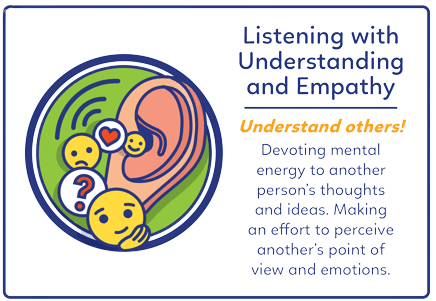
(PT-BR)
‘Hábitos da Mente’ no contexto da Educação Física: #3 Ouvindo com Atenção e Empatia.

O terceiro HdM é “Ouvindo com Atenção e Empatia”. Inicialmente, precisei conhecer mais sobre o conceito de empatia em si para entender como contextualizar o hábito conectando-o as dinâmicas de Educação Física.
- capacidade de se identificar com outra pessoa, de sentir o que ela sente, de querer o que ela quer, de apreender do modo como ela apreende etc.
- faculdade de compreender emocionalmente um objeto (um quadro, p.ex.).
Como professores de Educação Física, frequentemente usamos o terceiro “HoM” quando estamos explicando jogos e brincadeiras e os alunos não estão nos ouvindo, ou em muitos casos quando o próprio aluno está explicando ou fazendo algo em relação às aulas e indivíduos, pequenos grupos ou o grupo inteiro não estão ouvindo o(a) colega explicando.
Do dicionário de Cambridge: “Estar no lugar de alguém”: estar na situação, geralmente uma situação ruim ou difícil, em que outra pessoa se encontra:
Eu estou explicando algo novo para meus amigos e eles não estão me ouvindo.
Esse tipo de situação exigirá ter empatia enquanto ouço as regras das aulas com atenção e compreensão. Imagine que estamos tentando dar aula para uma turma com bagunça generalizada. Parece impossível, né?! E é. Chamamos educadamente a atenção dos alunos compartilhando o “HoM” e tentando conscientizá-los sobre o mau comportamento.







 felippe.net
Leave a comment